02.09.2026
International Expert on Integration of Media and Information Literacy (MIL) and Peacebuilding Competencies into School Textbooks
TERMS OF REFERENCE (TOR)
International Expert on Integration of Media and Information Literacy (MIL) and Peacebuilding Competencies into School Textbooks and Learning Materials
Duty Station: Bishkek, Kyrgyz Republic (with preparatory work conducted remotely)
Duration of Assignment: October – December 2026
Duration of In-country Mission: Minimum 5 working days in Bishkek, Kyrgyz Republic (tentatively November 2026
Implementing Organization: International Agency for Quality Assurance in Education “EdNet” (Public Foundation)
Project Partner: United Nations Children’s Fund (UNICEF)
Purpose of the consultancy is to conduct an international peer review of the national competency framework and textbook integration mechanisms; provide methodological expertise and training on embedding peacebuilding and Media and Information Literacy competencies into textbook texts, assignments, exercises, questions and learning activities for Grades 7–12; and strengthen capacities of textbook authors, curriculum developers, methodological specialists and education experts in developing competency-based textbook content aligned with UNESCO approaches and international practices.
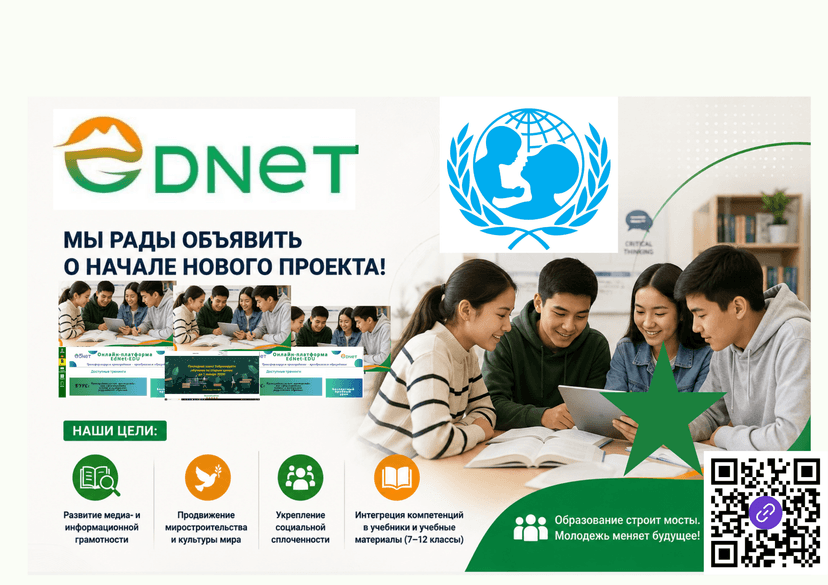
“Empowering Youth to Building Bridges for Social Cohesion through Education”
The Kyrgyz Republic is currently implementing a comprehensive education reform, including the transition to a 12-year school system and modernization of curricula, textbooks, and teaching-learning approaches. One of the key priorities is the integration of cross-cutting competencies that contribute to social cohesion, critical thinking, responsible citizenship, resilience to misinformation, and peaceful conflict resolution.
Phase 1 (Remote):
ü Review draft competency framework (Russian), integration matrices for Grades 7–12, methodological materials and supporting documents;
ü Conduct international peer review with written recommendations;
Phase 2 (Mission):
ü Development and Delivery of a Three-Day Training on Methodology for Integrating MIL and Peacebuilding Competencies into School Textbooks in Bishkek
ü Develop and administer pre- and post-training assessments;
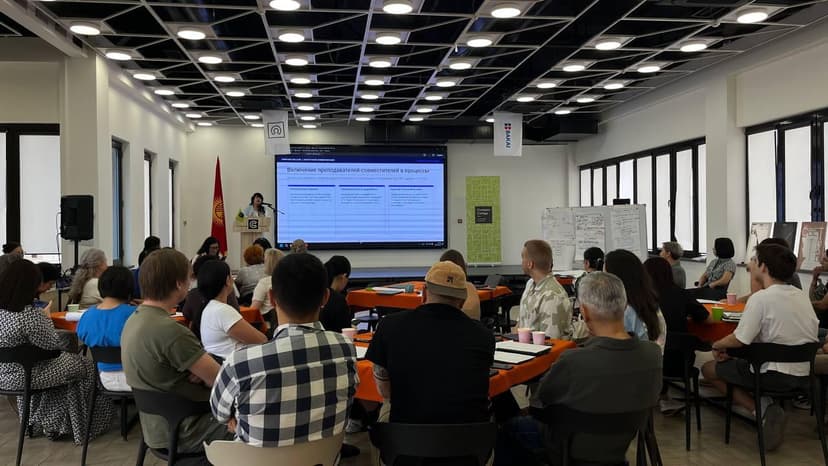
The International Expert shall develop and conduct a three-day practical training for textbook authors, experienced textbook and assessment developers, methodological specialists, curriculum developers, and national experts working on Media and Information Literacy (MIL) and peacebuilding competencies.
The training shall focus primarily on the methodology of developing textbook content, texts, learning activities, assignments, questions and assessment tasks that systematically contribute to the development of MIL and peacebuilding competencies among students in Grades 7–12.
The training shall be based on the competency framework developed under the project, which establishes the progressive development of MIL and peacebuilding competencies across Grades 7–12. The expert shall use this framework as the principal methodological reference for demonstrating how the expected level of competency development should be reflected in textbook content and learning activities at different grade levels.
The training shall demonstrate how MIL and peacebuilding competencies can be embedded organically within different subject areas, rather than presented as separate or stand-alone topics.
The training shall specifically address:
1. Understanding the competencies
The expert shall introduce the concepts, principles and components of Media and Information Literacy and peacebuilding competencies using the definitions and conceptual approaches established by UNESCO. All methodological approaches used during the training must be consistent with the UNESCO frameworks and reference materials provided to the expert by EdNet.
The training should establish a common understanding of:
- what MIL competencies mean in the context of school education;
- what peacebuilding competencies mean in the context of school education;
- how these competencies relate to critical thinking, responsible information use, communication, conflict prevention and peaceful interaction;
- how the competencies can be developed progressively throughout Grades 7–12.
2. Methodology for developing textbook texts
The expert shall demonstrate how to design and structure textbook texts so that they contribute to the development of the targeted competencies.
This should include practical guidance on:
- selecting topics and contexts through which competencies can be developed;
- structuring texts to stimulate analysis, reflection and critical thinking;
- developing age-appropriate texts for different grades;
- embedding opportunities for students to identify, analyse and evaluate information;
- incorporating different perspectives and viewpoints;
- developing texts that promote respectful dialogue, understanding of differences and peaceful approaches to disagreements;
- avoiding stereotypes, bias, discriminatory representations and potentially conflict-escalating narratives;
- adapting the complexity of texts to the expected competency level of students in Grades 7–12.
3. Methodology for developing textbook assignments and learning activities
A major component of the training shall focus on the practical development of school textbook assignments and exercises designed to develop MIL and peacebuilding competencies.
The expert shall demonstrate:
- how to formulate competency-based assignments;
- how to move from knowledge-recall tasks toward tasks requiring analysis, evaluation, interpretation and creation;
- how to formulate tasks appropriate to different levels of competency development;
- how to design assignments that require students to analyse information sources, identify bias or manipulation, compare perspectives, verify information and make reasoned judgments;
- how to develop tasks that promote dialogue, perspective-taking, negotiation, cooperation, conflict analysis and peaceful problem-solving;
- how to ensure that assignments are appropriate for the developmental level of students in Grades 7–12;
- how to adapt similar competency areas to different school subjects.
Participants should work directly with examples and develop their own sample textbook assignments during the training.
4. Methodology for developing textbook questions
The expert shall provide practical guidance on the formulation of questions that intentionally develop MIL and peacebuilding competencies.
The training shall demonstrate how questions can be designed according to the progressive competency levels established in the project framework, including the increasing complexity expected from Grades 7 through 12.
The expert shall demonstrate the difference between:
- questions testing factual knowledge;
- questions requiring understanding and interpretation;
- questions requiring analysis of information and sources;
- questions requiring evaluation and critical judgment;
- questions requiring application of competencies to real-life situations;
- questions requiring students to formulate solutions, arguments, alternative perspectives or constructive responses.
Particular attention shall be given to ensuring that the cognitive and competency demand of a question corresponds to the expected level of MIL and peacebuilding competency development for the relevant grade.
5. Methodology for assessment and evaluation of competencies
The expert shall demonstrate methods for assessing whether textbook texts, assignments and questions actually contribute to the development of the intended MIL and peacebuilding competencies.
Participants shall learn how to:
- identify which competency is targeted by a particular task;
- determine the expected level of competency development;
- evaluate whether a task genuinely develops the intended competency rather than simply mentioning the topic;
- develop criteria and indicators for assessing student performance;
- formulate assessment tasks and rubrics appropriate to different competency levels;
- review existing textbook content from the perspective of competency development.
6. International examples and comparative practice
The expert shall present relevant examples of textbooks, learning materials, assignments and assessment approaches from different countries where MIL, peace education, global citizenship, social cohesion or related competencies have been integrated into school education.
The examples should illustrate, where possible:
- how competencies are embedded in different subjects;
- how textbook texts are structured;
- examples of competency-based assignments and questions;
- progression of competency development across grade levels;
- approaches to assessment;
- mechanisms used to support textbook authors and reviewers.
International examples should be used not simply for information purposes, but as practical models for analysis and adaptation to the Kyrgyz educational context.
7. Practical application by participants
The training shall have a strong practice-oriented component. Participants should work in groups and/or individually to:
- analyse existing textbook texts;
- identify the MIL and peacebuilding competencies targeted by a text or task;
- assess the level of competency development;
- identify methodological gaps;
- redesign existing textbook texts and assignments;
- develop new questions and learning activities;
- develop assessment criteria for the proposed tasks.
Practical exercises should cover different subject areas and different grades within the 7–12 range.
By the end of the training, participants should be able to independently apply the methodology to the development and review of textbook content in their respective subject areas.
ü Review of competency framework and written recommendations (Before mission);
ü Training programme and agenda (Before mission);
ü Training presentations (Before mission);
ü Handouts and practical exercises (Before mission);
ü Pre- and post-tests (Before training); Delivery of 3-day training (November 2026);
ü Participation in consultations and validation meetings (During mission);
ü Final consultancy report (3–7 pages) (Within 10 days after mission).
REQUIRED QUALIFICATIONS AND EXPERIENCE
ü Advanced university degree (Master’s or PhD) in Education, Curriculum Development, Educational Sciences, Media and Information Literacy, Peace Education, Global Citizenship Education, Social Sciences, or related fields.
ü At least 10 years of experience in curriculum, textbook or educational content development;
ü Demonstrated experience integrating MIL, peace education, GCED, social cohesion or related competencies; experience designing textbook content and competency-based materials;
ü training experience;
ü Knowledge of UNESCO frameworks is an advantage;
ü Multicultural/ multilingual/conflict-sensitive context experience is an advantage.
· Media and Information Literacy (MIL) Peacebuilding
· Global Citizenship Education (GCED) Curriculum Development
· Textbook Development Competency-based Education Inclusive Education
· Conflict-sensitive Pedagogy Social Cohesion
· Critical Thinking Responsible Citizenship Resilience to Misinformation Training and Facilitation Learning Assessment
· Peer Review
· Excellent command of English is required;
· Knowledge of Russian is an advantage;
100% payment upon completion of all deliverables, submission and approval of final report, and acceptance of all materials by EdNet. Travel expenses to Kyrgyzstan are covered and purchased by EdNet.
APPLICATION REQUIREMENTS
Interested experts are invited to submit the following documents:
1. Curriculum Vitae (CV) – a detailed CV demonstrating the candidate’s relevant academic qualifications, professional experience and expertise in:
2. Financial Offer – the candidate’s proposed professional fee for the entire assignment, expressed in USD and inclusive of all applicable taxes and fees.
3. Candidates may additionally provide a brief description of their relevant experience or selected examples of previous work demonstrating their suitability for the assignment.
Applications or any questions should be sent to office@ednet.group with CC to onolkan.u@ednet.group